


Summary: This blog post summarizes a real estate scouting trip we took to Boston, Nashville and Atlanta in May of 2018.
We’ve spent the last three weeks scouting the Boston, Nashville and Atlanta markets looking for real estate investments. We were motivated to check out these markets for a couple of reasons.
First, we want to diversify our holdings. Currently all of our properties are in Washington state (though at the time of this writing we are in process of buying a 6-plex in Oklahoma City), so we worry about a huge portion of our holdings being wiped out by a natural disaster or a downturn in the local economy.
Second, we want to be prepared with teams in place in the event of an economic downturn, so we can scoop up properties at a discount quickly.
And finally, we scouted these markets for our readers, so we can share information about these markets and our contacts if you want to invest in these locations.
Boston Trip Report
Rents in Boston are considered some of the highest in the nation (number 4 out of 50 states) with average rent for a one-bedroom and two-bedroom apartments running $2,300 and $2,700, respectively. In recent years, high prices have pushed renters to move outward into neighborhoods close to or outside city lines, causing rents to go higher in these areas as well. A robust economy and numerous universities make for a strong market. And not surprisingly, the prices of the buildings reflected the booming economy.
Prior to visiting Boston, our agent directed us to become familiar with areas north of the city (Chelsea and Malden) where she thought we might be able to find properties that could cash flow. However, during our visit, there were no good deals in those areas so we ended up spending most of our time viewing typical “triple-deckers” in neighborhoods south of the city.
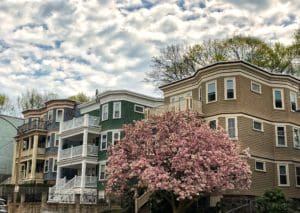
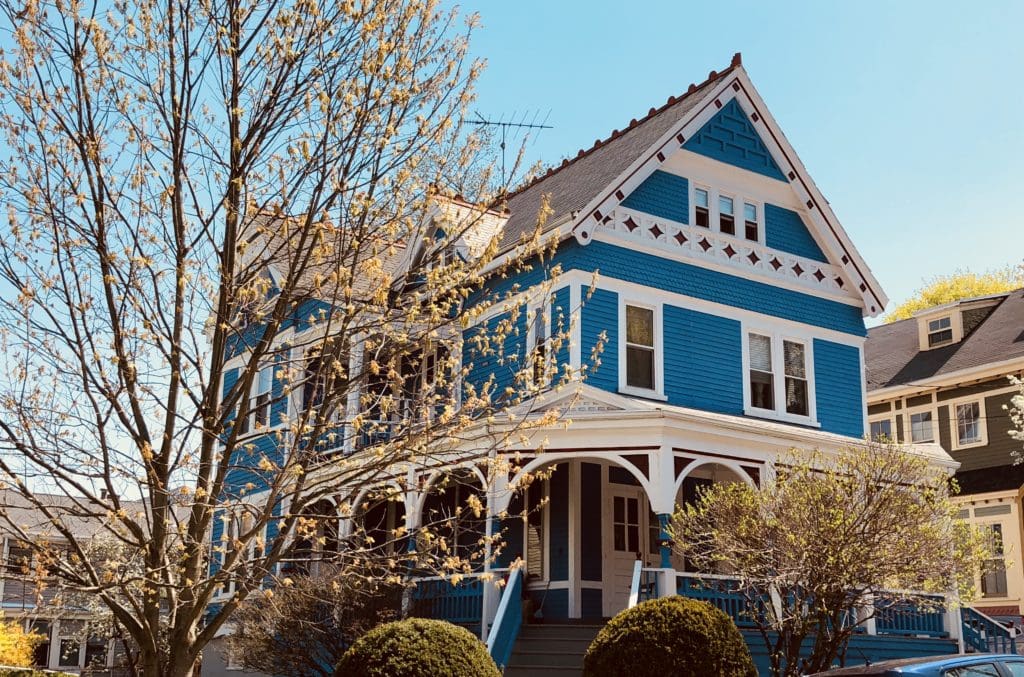
Triple-deckers are wood construction buildings which usually consist of a single apartment per floor, often with a deck in front of each unit, which give them their characteristic appearance. Our agent advised us that even though triple-deckers are quite old (the heyday of building triple-deckers was in the late 19th and early 20th centuries), they often withstand the test of time much better than units constructed in the 1960s and beyond. Some of the units in the triple-deckers we viewed were quite large (up to 1500 sq feet) and, when rehabbed, our agent thought could net about $3,000 per unit (3 bedroom/1 bath in the Jamaica Plain neighborhood). We saw a range of units from fixed up versions to buildings requiring an estimated $100K+ in repairs. Most triple-deckers in desirable neighborhoods seem to run in the $800K to 1.2 million dollar range.
Most of the units we viewed were in Jamaica Plains and Roxbury.
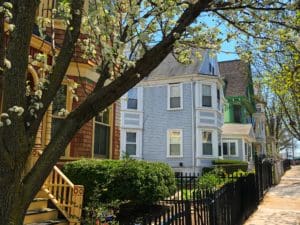
According to our agent, prices in Jamaica Plains have been rising the last few years (by 10% in 2017), however, she felt that the area still had some room for appreciation. Roxbury is a neighborhood beyond the the last station of the T subway line, but apparently is quite easy for commuters to get into town as there is a separate commuter train they can take into town. Prices remain slightly lower, so our agent felt that appreciation would be higher over time, especially if the fare structure for the T subway and commuter train line were to be combined in the future (as is being discussed).
We found both neighborhoods to be charming with beautiful central avenues with lots of shopping and restaurants. Definitely somewhere we would live. We did check out one rehabbed triple-decker in Dorchester, which was a noticeably rougher neighborhood comparatively, though we can imagine that it will become gentrified in the next several years. As noted above, our agent advised that investors may be able to find better cash-flow in areas north of the city such as Malden and Chelsea.
During our visit, we also met with property managers associated with our real estate agent’s brokerage house. They concentrate on servicing properties mostly in Jamaica Plains and the adjacent areas and don’t go north. They confirmed that the market is extremely strong and that they rarely have vacancies. One of the most interesting things we learned from the property managers was that there is essentially zero vacancy since the demand for rentals is so strong. They are able to achieve zero vacancy by writing into new leases that work can be done on the unit during the first few weeks while new renters are moving in.
For example, one set of renters move out the last day of the month (leaving the unit “rent-ready” clean) and the next set moves in the next day. Any light repairs or upkeep can then be done while the new renters are in place. We were assured that if cleaning was necessary, it would get done quickly so there was no turnover time as well. One other pearl we learned was that the leasing fee or “broker fee” is covered by the renters not by the owner. In most markets, you have to pay the property manager as much as one month’s rent to find a new renter. In Boston, the tenant pays this fee.
Take Away Points
- You may be able to find value by rehabbing older triple-deckers (if you can buy them before the developers turn them into condos) and adding extra units in the basements and ½ bathrooms in closets.
- Most property owners do not allow pets so you can charge higher rents ($150-200 per month) to pet owners (it is illegal to charge a separate pet rent like you can in most markets).
- It is illegal to charge back utilities to renters if your units are not individually metered.
- Landlords are responsible for keeping common sidewalks clear of snow (if you don’t, you get fined by the city)
- Parking is at a premium so you can generate extra revenue by charging parking fees.
- Tenants pay a “brokerage” fee, which is generally one month’s rent, to the property manager to rent a unit. This means the owner does not need to pay the property manager to initially rent a unit or to renew a lease.
- The market does support renting garages.
- You need a lawyer to close on a property in Massachusetts.
Our overall impression of the Boston market is that it is a sustainably strong market, allowing for owners to be in a good position now and in the future, however, it is very difficult to find properties that meet the 1% rule or 10% cash-on-cash return unless you go fairly far out of town or buy a property in need of a lot of rehab (at which point you are probably in competition with developers doing condo conversions).
Who is this market right for?
Someone with a significant down payment looking for a sustainably strong market who is willing to accept lower rates of cash flow (but higher appreciation) and who is not worried about investing in older buildings.
Nashville Scouting Trip
Nashville has been booming for at least a decade with strong job growth due to the high density of healthcare corporations, universities, manufacturing and, of course, the music industry. In recent years, the city has been recognized as having one of the hottest housing markets and there has been a lot of interest in real estate investing in the city. Nashville has also been recognized as having one of the strongest Airbnb markets.
We’ve been remotely checking out properties in Nashville and building relationships with our team there for over a year. We even made offers on two properties late last year (4-plex and duplex), located in small commuter communities outside of town, which did not work out. We’ve actually moved through a couple of agents during this time to find the right fit.
When we first started looking at the Nashville area to invest, we had assumed that we would need to go fairly far out of town in order to find something to meet our cash-on-cash criteria. One thing we were surprised to learn from our agent was that he does find off-market deals inside of city lines that can meet our criteria. It’s just a matter of being patient and well connected. He told us that if a property shows up on the MLS it’s a bad deal. It’s the off-market deals or the places that have been on the MLS for 500 days (so you can get a serious discount) that he considers to be reasonable buys. Therefore, during this visit, we spent a couple days in Nashville driving the city to check out neighborhoods instead of looking at current listings so that when the off-market deals do come up, we’ll be familiar with the areas and ready to move fast.
Our agent suggested we check out the Belmont/Hillsboro, 12 South, Buena Vista, Woodbine and Glen Cliff neighborhoods. He also suggested driving out to the small city of Murfreesboro, about 30 mins out of the city, to check out the neighborhoods around Middle Tennessee State University (20K+ students).
We spent a fair amount of our time in the Belmont/12 South area because it is such a great neighborhood with excellent restaurants, playgrounds, parks and ice cream (the local ice cream shop even had goat cheese cherry flavor!). We found Buena Vista and Woodbine a bit rough around the edges. Then, we visited Murfreesboro and drove the neighborhoods and the main street (which was beautiful). We could definitely see how buying even a single family home near the university and renting it to students or a professor could be a cash-flow and appreciation play.
In addition to our real estate agent, we also visited with a property manager and his team in Nashville.

We’ve been in communication with this particular property manager for about a year, and he’s checked out properties in person for us and provided us with both estimated rental pricing and feedback about repairs. He advised us that properties rarely remain vacant in town and the surrounding areas. To us, the rental situation sounded very similar to Seattle, with the cost and time of unit turnover and rental and lease renewal being fairly similar. Garage leases are not common in Nashville, but people are familiar with pet rent.
Take Away Points
- You can find deals within the city limits if you find off-market properties or find properties with hidden value (e.g., basement units, extra bedrooms).
- There are a number of neighborhoods in close vicinity of downtown where you can find properties with decent cashflow and the added bonus of rapid appreciation.
- If you can find a small house or multiplex a bike ride or walking distance to Middle Tennessee University, the numbers may work.
- Nashville has a strong Airbnb rental market. Property management expenses range 17-22% for Airbnbs.
We really enjoyed our time in Nashville and found it to be a very livable city. Since it has been a hot real estate market for some time, investors have already scooped up a lot of deals, so it may take some time to find a property.
Who is this market right for?
Everyone, because there are so many options. If you purchase outside of the city, you can probably find a less-expensive property with decent cashflow. If you purchase in Mursfreesboro, you can find single-family homes and small multi-families that don’t require a large down payment. Also, if you are patient and able to find something in town, you may need to settle for slightly lower cash-on-cash return, but your property is likely to have low vacancy and appreciate faster than properties outside of the city. You might even be able to Airbnb the unit for higher returns.
Atlanta Scouting Trip
Like Boston and Nashville, Atlanta has been a hot spot for real estate investing in recent years. While neighborhoods within city limits have seen prices soar, areas north of Atlanta including cities such as Marietta have also been recently recognized as solid areas for investment.
Our real estate agent advised us to primarily stick north of the city to achieve our cash-on-cash criteria. He reported that good properties could be found in Gwinnet county (which includes cities such as Duluth, Suwanee, Peachtree Corners) and Cobb county (which includes Marietta, Smyrna, Powder Springs). These areas have desirable school districts as well, so the market for single family homes is fairly strong. Unfortunately, due to recent price surges, he let us know that it could be difficult to find anything newer that met our cashflow criteria. We’d likely be concentrating on multi-family buildings from the 1980s.
When we visited Atlanta, we spent several days driving around cities in the north checking out a range of properties.
We saw raw land, single family homes, a number of duplexes and four-plexes and even several properties with 12+ units.
We like to focus on 2-4 unit multifamily residences, but unfortunately we found that many of the 2-4 unit multifamily residences are built in large neighborhoods of similar-appearing multifamily buildings. I say unfortunately because this means your fortune as an owner is largely tied to whether your neighbors upkeep their buildings (see picture). As we saw time and time again, if one landlord lets his/her building fall into disrepair, it can take down the whole neighborhood.
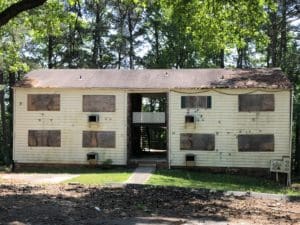
In addition, a prospective renter has a lot of units within the same neighborhood to compare. This means that your rents really need to be in line with the other surrounding units.
Because of this, we found that we favored the single family homes and the larger properties in the Atlanta area. We found some rougher single family homes that would require repair but could cashflow. For example, one 4 bedroom/2 bath single family home listed near $200K in Marietta that our real estate agent felt could be purchased closer to $175K, rehabbed for approximately $20K and then rented for $1750 per month. The other benefit of getting a single family home over a duplex is that the renters will cover all utilities, whereas with multifamily residences, you may have to pay for the shared utilities or anything that isn’t separately metered (e.g., sewer).

The larger buildings we saw with >10 units did sometimes get closer to the 1% rule, but due to expenses (utilities, taxes, maintenance) and, of course, the higher expenses of a commercial loan, we couldn’t find anything meeting our criteria.
During our visit, our real estate agent also introduced us to a wonderful general contractor, who does maintenance work for some of the local property managers but also can build properties from the ground up and is currently flipping foreclosures. We also spent some time with a highly-rated property manager whose company manages 650 rentals across Atlanta. She also confirmed that properties north of the city would rent best, and advised us that some areas can support billing back utilities. Property management expenses seemed in line with those found in Spokane and Nashville.
Take Away Points
- If you invest in a multifamily residence that sits in a neighborhood of similar looking residences, your returns can be at risk if your neighbors don’t upkeep their properties.
- Marietta is a desirable area, but you can find some rough patches even close to nicer neighborhoods, so it’s important to have your agent and property manager go see the property and the neighborhood.
- To get close to 10% cash-on-cash return, you have to go fairly far north outside of the metropolitan area of Atlanta.
- Buying land and building could be a good option.
- You can find some beautiful multifamily residences near Piedmont Park in Atlanta, however, cashflow is a problem.
Overall, we found that you can find properties that have decent cashflow north of Atlanta. However, the market is fairly competitive so you’ll likely find that “hot” properties will have multiple bids and prices can climb well above the list price. We discovered that you need to be cautious when investing in 2-4 unit multifamily residences because they are typically built in neighborhoods of similar looking properties. As a result, we have personally shifted our focus on single family homes and larger buildings.
Who is this market right for?
Like Nashville, we think this market can be right for everyone. One of the benefits of Atlanta, over say a place like Boston, is that you can still find properties if you have a smaller budget. While most Boston properties are in the $700K+ range, some properties north of Atlanta can still be scooped up for less than $150K. If you are willing to do some level of repair/rehab and/or construction, the resulting cashflow can also be decent.
We hope you enjoyed our brief wrap up of the unique features of the Boston, Nashville and Atlanta markets. We’ve made a lot of great contacts in each of these markets, so hopefully we’ll be writing posts in the next couple of months about new properties we’ve found and purchased in these areas!


