Summary: This is the final installment of our 2020 real estate review. In Part I, we covered the details of properties we sold in 2020. In Part II, we looked at 2 of the 4 properties we purchased in 2020. For our final installment, we’re discussing 2 more properties we purchased in 2020—one of which was a short-term rental! The goal of this series? To share our experiences so you can learn from them and apply them to your own rental business.
Lessons from the 16-Unit in Tacoma, WA
We decided to buy one more multi-family property to close out the year. This is a 16-unit multi-family property we purchased for $2,030,000 in winter of 2020.
Before we tell you the story, here’s a snapshot of what we learned.
Learning pearls:
- Sometimes, a property just needs time on market to come down to a reasonable property sales price. So if you find a property that would make sense to acquire if the price came down, I’d suggest “hearting” it on your preferred real estate app and following it for a while.
- If that property doesn’t sell for a month or two, you now have the opportunity to approach the seller with negotiating power.
- There can be huge problems with funding a commercial deal if even only 1 or 2 units are non-paying. But, this is a great opportunity for all of us to get reductions in prices on multifamily properties in the next 6-12 months.
- #Understatement: Securing Fannie Mae funding means jumping through a lot of hoops.
Why did this property interest us?
Sheltering our income: We were looking for one more property to help us shelter our income for 2020. This 16-unit in Tacoma would give us the additional losses we needed to do so. We also wanted to have extra income to carry back or forward our losses, as we explain in this article.
Turnkey: We also liked it because it was a relatively turnkey property. Typically, Kenji and I like to purchase properties we can fix up. However, we already had 2 major renovation projects going on—so we decided not to play it in hard mode.
Forced appreciation: There were definitely opportunities for forced appreciation! We could potentially add an additional unit, or convert one of the units into a two-bedroom unit. The rents were slightly under market, and we could bill back more utilities as well. All of these changes would result in great cashflow and modest forced appreciation.
Getting a Fannie Mae card: Kenji learned a lot from this deal. We ended up buying the property with a Fannie Mae small balance multifamily non-recourse loan. It was a crash course in the paperwork, lawyers, environmental studies, additional loan qualifications, etc. The upside is that Kenji earned his Fannie card! This will make it easier for us to secure government-based financing in the future.
The challenge
The day before closing, we discovered the seller had actually reported that 3 units hadn’t paid rent that month. So the lender decided we needed to show up to the closing with more than $300,000 added to our down payment.
Fortunately we have great people on our team. Our lender stayed cool and had our back. Our agent communicated well with the seller’s agent. In the end, everything got resolved, and the loan finally closed about a month late. Luckily we closed before 2020 ended and within our 1031 exchange window, so we didn’t have to deal with a repeat of what happened with our 32 unit.
Believe it or not, this was the easiest of our deals this year. There’s a trend here with how much mindset and a strong “why” drives you. There are inevitable challenges that come with building a real estate portfolio.
The Single-Family Home, now Short Term Rental, in Index, WA
We were excited to buy our first short-term rental! We purchased it for $660,000 in the fall of 2020.
Let’s start with what we learned before getting into the deets.

Learning pearls:
- Short-term rentals can generate significant tax savings, even if you do not meet the criteria for real estate professional status.
- There are specific requirements you must meet to be able to use the losses generated from bonus depreciation, your renovation project and furnishings to shelter active (W2) income.
- When considering purchasing a short-term rental, be sure you run the numbers ahead of time using a cash-on-cash calculator.
- Short-term rentals can cashflow at a higher rate than long-term rentals. However, they also mean more work and higher risk.
Why did this short-term rental property interest us?
Two birds, one stone: Being locked down in COVID made us fantasize about owning a vacation home that could serve as a welcome escape. Luckily, I have an obsession with Redfin. After about 6 months of daily searching, one afternoon, I finally saw the right property pop up.
Beautiful location! It was a river-front cabin in the mountains, about 30 minutes from a ski-resort and about one hour drive from where we live just outside Seattle, WA. It’s a perfect opportunity to be use it as a short-term rental. We could turn it into a year-round rental, instead of just a place that would only have demand in the summer, for example.
The short-term rental challenge
We immediately called the listing agent. I wanted to “lock it up” but in the end, the agent wanted us to come see the property to make sure we liked it. She was not OK with someone going under contract on the house unseen.
Unfortunately, as a result, we got into a bidding war with 6 other buyers. Luckily we won the property, though it cost us an additional $85,000. Part of the reason we were willing to go up on the list price, though, was that we knew this short-term rental was more than just an investment for us. It’s a place where we’ll probably spend time in the future and maybe even convert into a primary home somewhere down the road.
With that being said, we knew the numbers still worked decently as a short-term rental once we spoke to a property manager and got a sense of the actual nightly charge they’d suggest and the expected vacancy rate.

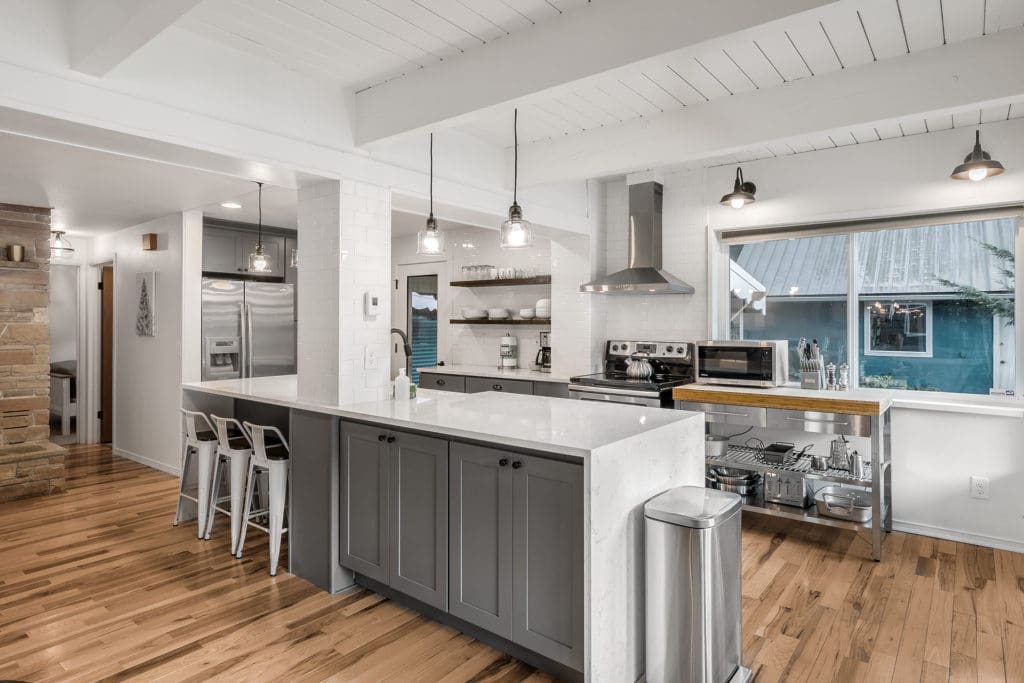
Outcome: We bought this property in early September, immediately starting a rehab project to fix up the kitchen. We wanted to update the house and rearrange the master bedroom space so that the bed could overlook the river. Our rehab project took over two months to complete.
Payoff: We then outfitted the house (which took up quite a bit of our time), and finally started renting it as a short-term rental in December. The reason we chose to do the work on the property and self-manage it in 2020 was to ensure we tapped into the significant tax savings associated with short-term rentals. This works even if you don’t have REPS. In the end, this property alone created >$250,000 in a tax-shelter for us in 2020.
For more information on this short-term rental project, check out our podcast episode about it.
In summary: 2020 was a great year for our real estate portfolio!
Let’s take a snapshot here too!
- We had many learning opportunities and challenges to help us work on our mindsets.
- Then, we harvested a lot of the lazy equity that we had locked up in our long-term buy-and-hold properties.
- We increased our cashflow significantly, and generated a 7-figure tax-shelter by 1) selling all our older properties and 2) 1031-exchanging them into new properties.
- We were only able to afford this huge amount of real estate because we used the forced appreciation and market appreciation from our older investments to buy our new ones.
Finally, since we’re now buying bigger properties, we’re increasing our efficiency and potential speed for growth in the future.
What will 2021 bring for us… and for you?