Summary: Real estate investing can be a substantial tax shelter for high income professionals if they claim Real Estate Professional Status. But is it fair for those who claim Real Estate Professional Status to significantly reduce their taxes and sometimes pay zero income tax? This post explains why it is not only fair, but also why the government created this very significant tax incentive.
“I want to pay my fair share of taxes.”
This is a statement we have now heard several times when discussing the benefits of Real Estate Professional Status and the tax advantages of real estate investing in general. We understand the sentiment. Fundamentally, we all want to contribute financially to our country and state to pay for schools, healthcare, roads and bridges and to provide resources and programs for those in need.
With that being said, I suspect very few of us have voluntarily sent in a check for an extra $10,000 to the government at tax time.
So where do you draw the line between what tax rate is “fair” for someone (or yourself) to pay?
In this post, we discuss why the low rates that active real estate investors pay in taxes is justified, so much so that the government goes out of its way to create tax incentives for investors. We also show you how real estate investors actually pay more in taxes than the average taxpayer (i.e., investors pay less in personal income taxes but generate more tax revenue for the government through their economic activity). By the end of this post, you’ll see why Real Estate Professional Status is actually fair. However, this post does not address how physicians can obtain Real Estate Professional Status. We’ve covered that in a previous post.
You can also download our free Quick Guide to Real Estate Professional Status to use as a reference.
This post is also not meant to serve as tax advice, for which you should rely on your own professional tax advisor.

Download the Quick Guide to Real Estate Professional Status
First of all, let’s look at your taxes…
Most physicians are first and foremost W2 or 1099 wage earners. Wage earners have very few deductions, but high income wage earners have even fewer as most deductions are phased out after a certain income level. Even worse, their income is directly correlated to the amount of time they work.
On the flip side, investors, like the ones who own the land your clinic or hospital sits on, likely earn more than you and put in very little time to earn that income. On top of that, it’s likely that most of their income is sheltered, so they pay very little taxes on that income.
How is this fair?
I suspect most of us think this is innately unfair. How is it that the people devoting most of the days of their lives to work pay the highest taxes while the people who leverage the work of others through business ownership or investing have lower tax rates and are doing less work?
Why has the government set things up this way?
There are probably a lot of reasons and special interest groups aside, one of the main reasons the government has set things up this way is to stimulate the economy. The government has determined the best way to do that is to create tax incentives benefiting those who are “more productive” by creating wealth for not only themselves but for others as well. These are the entrepreneurs who start businesses, investors who fund those businesses and real estate investors. To these groups, the government gives tax incentives in the form of tax deductions to encourage their activities and stimulate the economy.
Real estate investors get special treatment from the government because on top of the usual business deductions, they get the gift of depreciation, which is an extra write-off that is unique to real estate. Because of depreciation, it’s common for a cash-flowing property to look like it is losing money each year. This means that your properties can generate real income that you put in your pocket, and you don’t pay any taxes on it. And as a Real Estate Professional, you have the additional benefit of writing these paper losses off of your clinical income. For an example of how this works, click here.
Why do real estate investors get this special treatment? In his book, Tax-Free Wealth, Tom Wheelwright explains that the government needs someone to provide housing and commercial space to the public since it’s not in the market of supplying it. If there weren’t real estate investors building and running multifamily properties, who would provide and manage the country’s rental housing market?
If you don’t think your taxes are fair, stop being average and become an “economic engine”
Tom Wheelwright perhaps puts it best in his book when he separates “average taxpayers” (that’s W2 and 1099 wage earners) from “super investors.” In his book, Wheelwright states that the way to avoid paying high taxes is to stop being average and “contribute more to the economy” by becoming what he calls a “super investor,” since it’s the super investors who can access deductions and depreciation.
Real estate super investors are those who “actively” participate in real estate. Active investors are those who buy and manage their own properties rather than putting their money in passive investments such as REITs or real estate syndications. The tax code clearly favors active real estate investors by allowing them to write off any real estate losses off of earned income, something you cannot do if you are a passive investor.
Now, given all this, let’s say you still feel the tax incentives for real estate investors are unfair. Let us show you how real estate investors are contributing more to the economy by becoming an “economic engine” and generating more tax revenue for the government than the average taxpayer.
How much does an active real estate investor pay in taxes compared to an average taxpayer?
Active real estate investors generate a considerable amount of economic activity through their rentals. Think about all of the repairs required for the upkeep of a property and all of the people involved in helping them manage their property. (E.g., property managers, contractors, cleaners, landscapers, pest control, accountants and lawyers.) Also think about the people who help you buy and sell these properties. (E.g., real estate agents, title/escrow officers and home inspectors.) All of this activity results in tax revenue for the government, whether it is sales tax, property tax or income taxes paid by the vendors you hire.
But exactly how much tax revenue does an active real estate investor generate and how does this compare to what an average taxypayer pays in taxes?
In order to answer this question, we looked at our own real estate portfolio and came up with estimates for the tax revenue we generated for the government in 2017. We then came up with an estimate for the amount we would have paid as average taxpayers. In this illustrative example, we assume that the average taxpayer is a physician couple who makes $400,000 a year. For the real estate investor couple, we assume they make about the same amount of income, but they shelter a significant portion of their clinical income. In both cases, we assume both couples own homes and pay the same amount of taxes and mortgage interest on their personal residence. Therefore, we did not include this in the table below.
In 2017, we estimate that we generated over $130,000 in tax revenue for the government compared to $85,000 (we used Tax Foundation’s online calculator to come up with this estimate) if we were average taxpayers and didn’t have a real estate business (see Table below). And this doesn’t even include the tax revenue we generated from purchasing new properties in 2017.
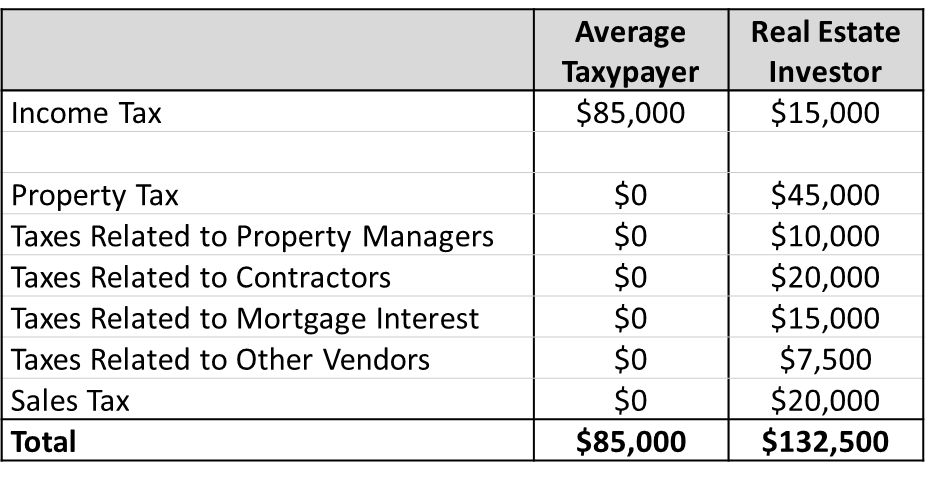
The following is how we derived each line item in the Table above.
Property taxes
When you own a significant amount of properties, the amount of property tax you pay to your local government can really add up. For example, I added up all the real estate taxes we pay yearly and found it was approximately $45,000 in 2017. It will be even more this year. That’s a lot to put towards our education systems, roads and social programs.
Taxes from payments to property managers
We use four different property management groups, and we pay each of them monthly fees. These fees pay for a portion of salaries for the owner of the property management companies and their employees. We estimate we paid approximately $40,000 in property management fees in 2017, which likely resulted about $10,000 in taxes assuming a 25% effective tax rate.
Taxes from payments to contractors
In 2017, we used three different contractors and spent approximately $80,000 in labor costs. This money represents income for the contractor and their workers. Assuming they pay an average of 25% in taxes on this income, we generated about $20,000 in taxes for the federal government.
Taxes from mortgage interest payments
Mortgage interest represents income for the bank. It’s hard to know how much of this interest is taxed because as a business, they have access to deductions that most individuals do not. For the purposes of this post, let’s assume they pay 15% tax rate on the interest that we pay on our loans. In 2017, we paid about $100,000 in mortgage interest so this represents $15,000 in tax revenue.
Taxes from payments to other vendors
We have multiple other vendors to whom we pay smaller amounts but, added together, these small payments are significant. These include lawyers, real estate agents, CPAs, insurance brokers, utility companies, and others like InCorp (registered agent) and Traveling Mailbox (commercial mail receiving agency). I estimate that we paid these vendors about $30,000 in 2017. Assuming a 25% tax rate, this represents $7,500 in taxes.
Sales Tax
Sales tax, especially in Washington State, is a big one. Every time we replace a roof, refrigerator or do a renovation, we pay nearly 10% sales tax. We estimate that we paid approximately $20,000 in sales tax in 2017.
Deferred taxes
Finally, although incentives like selling and buying investment properties through 1031 exchanges and doing cost segregation to speed depreciation can be seen as tax savings in the moment, these are ultimately just tax deferring processes. Eventually, when you sell a property, you’re going to have to pay the taxes you’ve saved along the way. (That is, of course, unless you keep a property until you die and pass it on to the next generation.)
Final Thoughts
Going through the exercise above, you can see that the amount of money that exchanges hands when running a real estate business is truly mind boggling. We are contributing much more financially to the economy than we ever would have as doctors paying our normal income taxes. We’ve truly become economic engines as the government so aptly encourages us to be through the tax code. Therefore, Real Estate Professional Status is more fair than you think.
Now, if you still feel bad using available tax incentives, you can always send the government an extra check each year after you’re done paying your taxes!
Action Plan
- Understand the requirements for becoming an active real estate investor and achieving Real Estate Professional Status
- Buy a significant number of properties and spend enough time working on them to be considered an active real estate investor
- Get an excellent CPA who understands the tax benefits of real estate investing
- Utilize all tax benefits and incentives to get as much money back in taxes early on in your investing career
- Re-invest this money and grow your business as fast as possible in order to take advantage of the power of compounding
- Throughout the process don’t feel guilty about the tax advantages you are getting since you are doing exactly what the government wants you to do – becoming an economic engine!